🍗 Resources -
Each region that a House claims gives the holding Player access to a resources board which they may manage in order to generate primary production and crafted goods.
There are three main resource types in Babayaga that pertain to a region’s production; Vittles, Goods, and Materiel.
Vittles -
Vittles represent any food, water and other necessary supplies that are required for the region’s health. Each region by default will create for itself enough Vittles to sustain its population without interference. The region’s sword token will note this basic ‘upkeep’ value and while the region is producing the same amount as it is consuming, it’s morale is considered to be in good standing. If for some reason a region begins to produce (or retain) less than its ‘upkeep’ number, then it’s resources board will show that it is in ‘unrest.’ A region that is in ‘unrest’ cannot provide a Table Banner to conflicts in that turn and it is vulnerable to Gambit’s targeting its population's loyalty. Vittles can also be traded as a commodity to other Players.
Goods -
Goods are used as the primary trading resource in the game. Goods are useful for the manufacturing of Materiel and for creating better efficiencies in Vittle production. Regions cannot begin to produce a surplus of either of these resources, without first placing goods on their resources boards in order to advance the associated tracks. There are two kinds of goods, domestic and foreign. The goods produced by one House will be of that House’s colour. Some region’s resource tracks will allow the placement of domestic goods to increase production. Other spaces on these tracks will require foreign goods, before the region can further increase their output. Houses cannot produce foreign goods and must trade with other Houses in order to collect goods of a different colour to their own, in order to satisfy this requirement.
Materiel -
Materiel is an abstraction of the fabrication of military products for use in warfare. If materiel is produced by a House’s industry, it will always take a space that could otherwise be used for the production of food or goods. One materiel can be exchanged for a draw of a single card from the battle deck, which can be used in the place of cards given to the Player in conflict. There is no guarantee that this card will be useful, but it does guarantee what that card is, and crucially, it removes a card from the battle deck for everyone else, while it is held. If the card is used in conflict, it is depleted and returned to the battle deck. If the Player/House chooses to use their materiel cards in conflict, they cannot retain other unused cards dealt to them in the Battle Order, they must return them as normal. This trade of for domestic production and warfare represents the associated power imbalance towards factions who place themselves in a war economy. Players should be careful not to over produce materiel because for every one unit produced, the region has lost the equivalent vittle production capability. If that ability drops too low the upkeep cost on the region will not be met, the region will go into a state of unrest, losing the House one Table Banner in conflict for that round.
Region Resource Board -
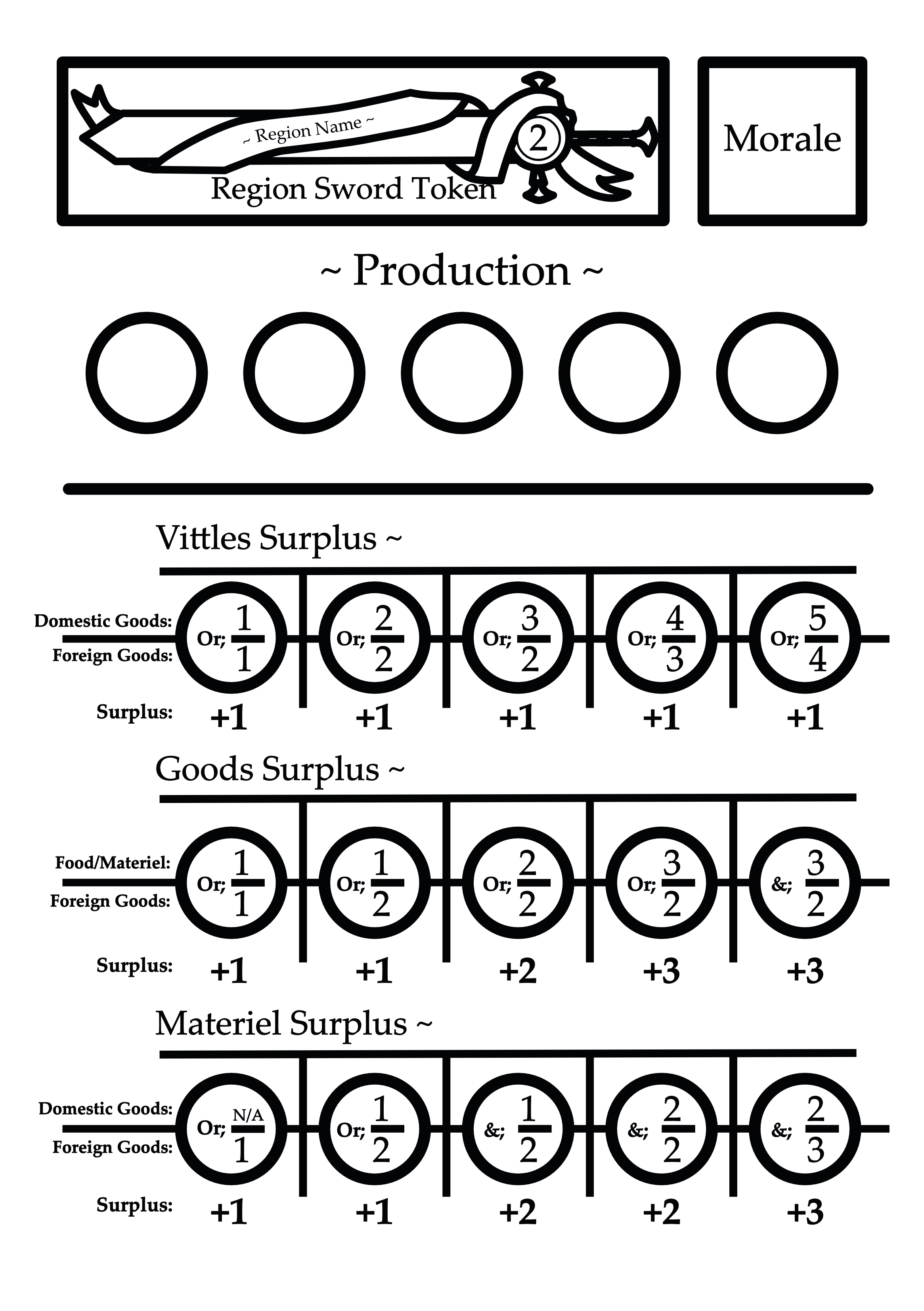
Generating Resources -
Beyond the Vittles required for upkeep, resource boards will show a track which provides a price for any additional surplus resources a Player may want to generate. Being a track, the Player is forced to generate up, from the basic production, to the more expensive options. This means that a Player cannot just pay the price to produce two additional Vittles from a region before they have paid the price for one. The total price for the second slot will be the cost listed on the first and second slot combined, in that round.
Resource boards are read by Control at the end of every round during Gloaming and the surplus resources distributed. Payment in a region for additional production (usually in ‘Goods’) is taken off the board by Control each round, resetting the production quotas to the base upkeep level every time.
Each region’s resource board will have five production slots. Depending on the number that any region requires for ‘upkeep,’ some of these slots will be prepopulated with the region’s necessary Vittles. The remaining slots are open for the Player to pay the surplus production cost and receive their resources. Players can choose to remove the upkeep Vittles, either to open a slot for other production, or to use the Vittles elsewhere, such as in trade. If Control reads a board that is below its upkeep cost at the end of the turn, it will produce that turn’s resources as normal but will be set to ‘unrest.’ When in unrest a region cannot produce any surplus until their basic Vittles are replaced up to the number listed for upkeep on their sword token. This resets every round so a region in unrest will not produce until the following turn, once Control has read a board and determined that it is back in good standing going into the start of a new round. Taking food from a region that needs it can be a necessary but risky manoeuvre.
Beta - There will be more examples here to explain how this mechanic works